From CSI 300 to MSCI China A Shares: How to Choose the Right Index Fund




Image Source: pexels
For you, buying index funds is one of the simplest and most efficient ways to participate in the Chinese stock market. The recent action plan by the China Securities Regulatory Commission, aimed at promoting investment in index-related products, provides you with a favorable policy environment. An increasing number of individual investors are entering the market.
| Account Type | October 2025 (in thousands) | November 2025 (in thousands) | Change (in thousands) |
|---|---|---|---|
| Stocks (Individual) | 2,302.604 | 2,372.150 | +69.546 |
| B Shares (Individual) | 0.408 | 0.474 | +0.066 |
| Funds | 156.800 | 168.800 | +12.000 |
Faced with numerous Chinese stock market indices, the key question is: which one is most suitable for you?
Key Takeaways
- Understand the characteristics of different indices, such as the CSI 300 representing large companies, the CSI 500 representing mid-sized growth companies, the ChiNext Index representing technology innovation companies, and the MSCI China A Shares representing the choices of international investors.
- Choose the appropriate index based on your investment goals and risk tolerance. Conservative investors are suited to the CSI 300, balanced investors can combine the CSI 300 and CSI 500, and aggressive investors can consider the ChiNext Index.
- When selecting specific index funds, consider the fund’s tracking error, fees, and fund size. The smaller the tracking error, the better; the lower the fees, the better; and the larger the fund size, the more stable.
- You can purchase ETFs through a stock account, or buy feeder funds or regular index funds via mobile banking or Alipay.
Understanding Mainstream Chinese Stock Market Indices

Image Source: unsplash
The first step in choosing an index fund is to understand the characteristics of different indices. Each Chinese stock market index is like a unique map depicting a specific area of the market. Below, we analyze four mainstream Chinese stock market indices to help you find your investment starting point.
CSI 300: Representative of Large-Cap Blue Chips
The CSI 300 Index consists of the 300 largest and most liquid companies from the Shanghai and Shenzhen markets. You can view it as a barometer of the Chinese economy, covering leading enterprises in most industries. Its characteristics are stability, making it suitable as a core allocation for long-term investment.
Its top 10 weighted stocks clearly demonstrate the dominant position of finance and consumption.
| Company Name | Sector |
|---|---|
| Kweichow Moutai | Consumer Staples |
| Ping An Insurance | Financials |
| Contemporary Amperex Technology | Industrials |
| China Merchants Bank | Financials |
| Midea Group | Consumer Discretionary |
| Wuliangye Yibin | Consumer Staples |
| Yangtze Power | Utilities |
| Industrial Bank | Financials |
| Zijin Mining | Materials |
| China Tourism Group Duty Free | Consumer Discretionary |
CSI 500: Mid-Cap Growth Engine
The CSI 500 Index follows the CSI 300 and includes 500 mid-sized companies with high growth potential. If you seek higher growth than large-cap stocks, this index provides an opportunity to capture the development of mid-sized enterprises. Its industry distribution is more focused on:
- Information Technology
- Industrials
- Materials
ChiNext Index: Frontier of Technological Innovation
The ChiNext Index consists of the 100 largest and most liquid companies on the Shenzhen ChiNext board. It focuses on high-tech and strategic emerging industries, representing the future direction of Chinese innovation.
Investment Tip: The listing requirements for the ChiNext board are relatively flexible, allowing high-growth companies that may temporarily fail to meet the main board’s financial standards to list. For example, the minimum market capitalization requirement for companies is approximately $155 million, with more flexible profitability record requirements. This fills the index with vitality and growth potential.
New economy and technology sectors account for over 50% of the ChiNext Index constituents.
MSCI China A Shares: Choice from an International Perspective
The MSCI China A Shares Index is compiled by the internationally renowned index provider MSCI, selecting Chinese A-shares from the perspective of global investors. This index serves as an important reference benchmark for many overseas funds allocating to Chinese assets. Paying attention to it can help you understand how foreign capital views and invests in the Chinese market.
How to Match Your Personal Investment Goals
After understanding the characteristics of mainstream indices, the next step is self-assessment. Your investment goals, risk preferences, and financial situation together determine which Chinese stock market index is more suitable for you. Below, we outline four typical investor profiles to help you identify your position.
Conservative Type: Focus on CSI 300
If your primary goal is capital preservation, pursuing long-term stable asset appreciation, then you may be a conservative investor.
Your Profile:
- Risk Aversion: You want investment volatility to be as low as possible and are willing to accept relatively lower returns for certainty.
- Capital Preservation: Avoiding principal loss is your core concern.
- Income Orientation: You prefer investments that can provide stable cash flows, such as reliable dividends.
For investors like you, the CSI 300 Index is an ideal starting choice. It gathers the largest and most stable leading enterprises in the Chinese market, with good risk resistance.
However, stability does not mean no risk. Even the CSI 300 can experience significant drawdowns in extreme market conditions. Historical data shows that the index has undergone notable drawdowns.
| Scenario | Maximum Drawdown |
|---|---|
| During 2013-2015 backtest period | 62.93% |
| Final drawdown after a certain adjustment | 8.87% |
This reminds you that even with a conservative index, you need to prepare mentally for long-term holding to weather the market’s cyclical fluctuations.
Balanced Type: Build a Core Portfolio
You may want to enjoy the stability of large-cap stocks while not missing out on the growth potential of mid-cap stocks. As a balanced investor, you seek the optimal combination of risk and return.
Your Profile:
- You are willing to bear moderate market volatility in exchange for long-term returns above average.
- You understand the importance of diversification and do not put all eggs in one basket.
- Your investment horizon is typically medium to long-term (e.g., 5 years or more).
For you, a classic strategy is to build a “core-satellite” portfolio. You can use the CSI 300 as the “core,” occupying a larger proportion to stabilize the portfolio’s foundation. Then, allocate a certain proportion to the CSI 500 as the “satellite” to capture high-growth opportunities in mid-cap stocks.
A common allocation plan is:
70% CSI 300 Index Fund: Obtain stable market returns.30% CSI 500 Index Fund: Enhance the portfolio’s growth elasticity.
This combination allows you to share in the growth dividends of China’s economic leaders while capturing opportunities from emerging industries and niche champions, achieving a balance between stability and growth.
Aggressive Type: Emphasize Growth Indices
Are you an aggressive investor? You have a long investment horizon and are not afraid of short-term market volatility, aiming to maximize capital appreciation.
Your Profile:
- High Risk Tolerance: You understand that high returns often come with high risks and can calmly face potential significant losses.
- Long Investment Horizon: Your investment goals may be decades away, such as saving for retirement or children’s education. You have ample time to recover from temporary market lows.
If this sounds like you, growth-oriented indices such as the ChiNext Index or CSI 500 will better suit your appetite. The ChiNext Index focuses on high-tech and strategic emerging industries, with constituents full of vitality and imagination, potentially offering the highest returns over the long term.
Choosing such indices means preparing for intense market volatility. But for you who are future-oriented, time is your best friend, helping smooth short-term fluctuations and allowing you to fully share in the long-term fruits of China’s innovative economy.
Global Perspective Type: Reference Foreign Capital Flows
You not only focus on the Chinese market itself but are also highly sensitive to global capital movements. You believe that following the footsteps of “smart money” can provide a unique investment perspective.
Your Profile:
- You are accustomed to thinking from a global macroeconomic perspective.
- You pay attention to cross-border capital flows and use them as one of the references for decision-making.
- You hope your investment strategy aligns to some extent with mainstream international investors’ thinking.
For you, the MSCI China A Shares Index is an extremely valuable reference tool. As it is the core benchmark for many overseas funds allocating to Chinese assets, tracking its fund flows can give you insight into foreign capital preferences.
You can understand how foreign capital invests in Chinese A-shares through the following main channels:
- Qualified Foreign Institutional Investor (QFII) and RMB Qualified Foreign Institutional Investor (RQFII) programs.
- Shanghai-Hong Kong and Shenzhen-Hong Kong Stock Connect mechanisms, which are currently the primary channels for foreign capital inflows.
You can follow fund flow reports released by third-party data platforms (such as EPFR, Trading Economics) to understand whether foreign capital is net inflow or outflow, and which industries and companies they prefer. Combining this information with the dynamics of the MSCI China A Shares Index can help you make investment decisions with a more global perspective.
Important Note: The above classifications and suggestions are general guidelines only. Before making a final decision, be sure to comprehensively evaluate based on your specific financial situation, liabilities, and actual risk tolerance.
How to Choose Specific Index Products
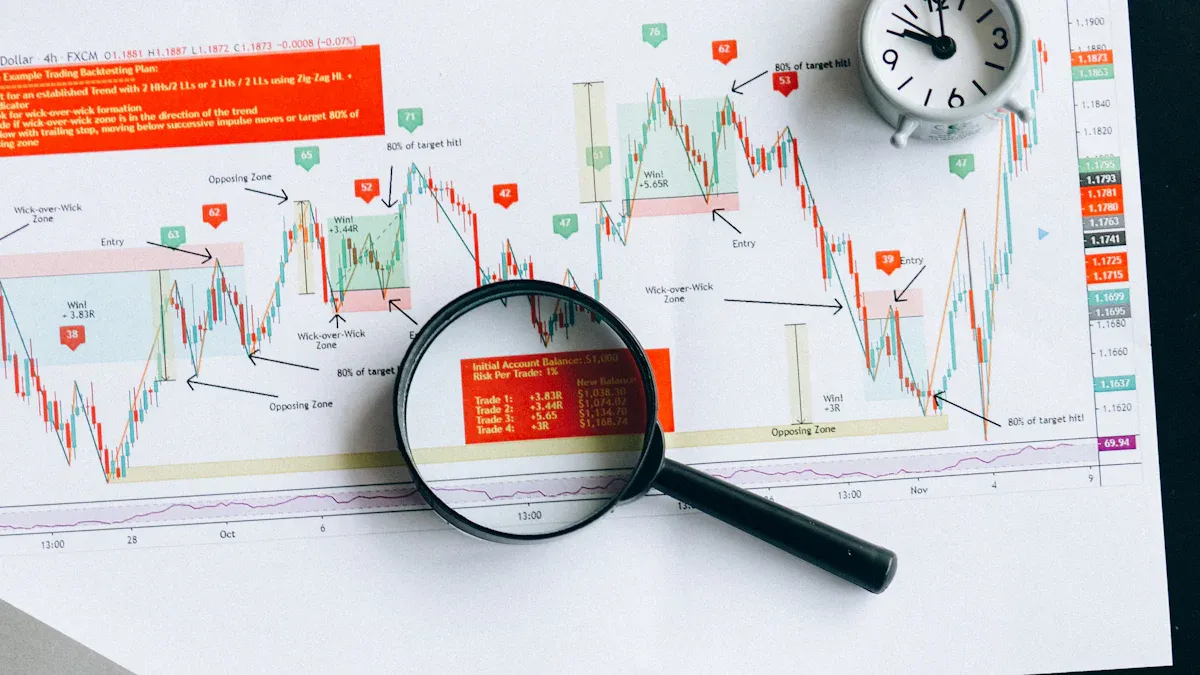
Image Source: pexels
You have selected your preferred index based on your goals; now comes the final step: picking the specific fund from the many products on the market. The key to this step is understanding different purchase channels and evaluation metrics.
On-Exchange Investment: ETF Trading Guide
If you want to buy and sell index funds in stock trading software, then ETFs (Exchange-Traded Funds) are your first choice.
What You Need to Prepare: An A-share securities account or securities investment fund account.
ETFs trade exactly like stocks; you can buy or sell at any time during trading hours at market price or a specified price. Its main advantage is extremely low fees. Trading commissions are typically around 0.004% of the transaction amount, and ETF trading is exempt from stamp duty, which effectively reduces your investment costs.
Off-Exchange Investment: Feeder Funds and Regular Index Funds
If you do not have a securities account, or prefer investing through mobile banking, Alipay, or other third-party platforms, off-exchange funds are a more convenient choice.
- Feeder Funds: They solve the problem of not being able to buy ETFs without a stock account. You can think of a feeder fund as a “transfer station” that pools your funds and primarily invests in its corresponding on-exchange ETF.
- Regular Index Funds: These funds directly replicate the index without investing through ETFs.
Both types of off-exchange funds handle subscription and redemption like familiar regular funds, confirmed daily based on net asset value.
Core Metrics for Evaluating Funds
Even funds tracking the same index may perform differently. You can evaluate and screen using the following three core metrics:
- Tracking Error: This metric measures how closely the fund replicates its benchmark index. Simply put, the smaller the tracking error value, the closer the fund’s performance is to the index, indicating stronger replication ability by the fund manager.
- Fees: This is your direct investment cost, mainly including management fees and custody fees. The lower the fees, the higher your final returns. For passive index funds, fees are usually very low.
Fee Type Common Rate Management Fee 0.15% /year Custody Fee 0.05% /year - Fund Size: The larger the fund’s asset size, the more stable its operation, better liquidity, greater resistance to market fluctuations, and lower risk of liquidation.
Information Query Channels: You can easily find data on all the above metrics on the fund company’s official website, prospectus, or third-party platforms such as Tiantian Fund Net.
The journey to participating in the Chinese stock market begins with choosing a Chinese stock market index that suits you. Remember, there is no best index, only the one most suitable for you. This article provides you with a clear three-step decision-making method: understand the index, match your goals, and finally select the specific product.
Now is the time to turn knowledge into action. Successful investing, such as long-term dollar-cost averaging into the S&P 500 index fund, proves the value of patience and discipline. Although experts have differing views on market prospects, your long-term planning is more important than predicting the market. Start your investment journey and let time be your most solid friend.
FAQ
Should I buy in a lump sum or use dollar-cost averaging?
If you are new to investing, it is recommended to use regular dollar-cost averaging. This approach spreads your purchase costs and eliminates the need to guess the best market timing. If you are experienced and judge the market to be at a low point, you can consider buying in batches as lump sums.
Can index funds lose principal?
Yes. The net value of index funds fluctuates with the rise and fall of the corresponding index. When the market falls, your investment may incur losses. Therefore, you need to choose an index based on your risk tolerance and prepare for long-term investment.
Do I need to invest in multiple index funds simultaneously?
Not necessarily. If you are a conservative investor, focusing on the CSI 300 is sufficient. If you want both stability and growth, you can build a portfolio including large-cap and mid-cap indices like a balanced investor. It depends on your investment goals.
For funds tracking the same index, which one should I choose?
You can prioritize funds with lower fees, larger scale, and smaller tracking error. This information will help you find products with higher cost-effectiveness and more stable operation. You can query these data through the fund company’s official website or third-party platforms.
*This article is provided for general information purposes and does not constitute legal, tax or other professional advice from BiyaPay or its subsidiaries and its affiliates, and it is not intended as a substitute for obtaining advice from a financial advisor or any other professional.
We make no representations, warranties or warranties, express or implied, as to the accuracy, completeness or timeliness of the contents of this publication.
Related Blogs of

A Blessing for Small Investors: Finding the Lowest Trading Cost US Stock Brokers


Master US Stock Trading Hours in One Article: Never Miss Pre-Market and After-Hours Opportunities


US Stock Market Holiday Countdown: How Investors Should Position for Next Week's Trading


Essential Apps for Getting Started with US Stock Futures: These Apps Will Turn You into a Pro
Choose Country or Region to Read Local Blog
 Australia
 Austria
 Belgium
 Canada
 Cyprus
 Czech Republic
 Denmark
 Estonia
 Finland
 France
 Germany
 Greece
 Hong Kong
 India
India Indonesia
 Ireland
 Italy
Italy Japan
Japan Latvia
 Lithuania
 Luxembourg
 Malaysia
 Malta
Malta Morocco
 Nepal
Nepal Netherlands
 New Zealand
 Norway
 Pakistan
 Philippines
 Poland
 Portugal
 Romania
 Singapore
 Slovakia
 Slovenia
 South Africa
 South Korea
 Spain
Spain Sweden
 Thailand
 The United States
 Turkey
 United Arab Emirates
 United Kingdom
 Vietnam
Contact Us




BIYA GLOBAL LLC is a licensed entity registered with the U.S. Securities and Exchange Commission (SEC No.: 802-127417); a certified member of the Financial Industry Regulatory Authority (FINRA) (Central Registration Depository CRD No.: 325027); regulated by the Financial Industry Regulatory Authority (FINRA) and the U.S. Securities and Exchange Commission (SEC).
BIYA GLOBAL LLC is registered with the Financial Crimes Enforcement Network (FinCEN), an agency under the U.S. Department of the Treasury, as a Money Services Business (MSB), with registration number 31000218637349, and regulated by the Financial Crimes Enforcement Network (FinCEN).
BIYA GLOBAL LIMITED is a registered Financial Service Provider (FSP) in New Zealand, with registration number FSP1007221, and is also a registered member of the Financial Services Complaints Limited (FSCL), an independent dispute resolution scheme in New Zealand.