US Stock Order Types Explained: Market, Limit, and Stop Orders – Which Is Right for You?



Image Source: unsplash
Do you want to immediately seize a rising trend but not know how to place an order? Or do you worry about price drops after buying and want to set a “safety net”?
When learning how to buy US stocks, you face a basic choice: use execution-guaranteed market orders or price-controlling limit orders. Interestingly, research finds about 75% of retail orders may be speed-pursuing market orders. But is the fastest choice always best for you? Understanding market, limit, and stop orders – these three core tools – helps you make wiser decisions in different trading scenarios.
Key Takeaways
- Market orders allow quick buying and selling of stocks but with uncertain execution price.
- Limit orders control buy/sell prices but do not guarantee execution.
- Stop orders help limit losses by automatically selling when price drops.
- Trailing stop orders dynamically lock in profits, letting gains run.
- Choosing the right order helps better manage risk and achieve trading goals.
Core Order Types: Market, Limit, and Stop Orders

Image Source: pexels
Understanding these three basic orders is your first step to effective trading. Each has different uses, suitable for different market conditions and trading goals.
Market Order: Speed Priority, Guaranteed Execution
A market order is the simplest and most direct trading instruction. When using a market order, you tell the broker “immediately buy or sell for me at the current best market price.”
According to the US Securities and Exchange Commission (SEC) definition, a market order is an instruction to buy or sell stocks at the current market price. Its biggest advantage is that as long as there are counterparties in the market, your order almost always executes.
This means very fast execution. For highly liquid ETFs like SPY or QQQ, bid-ask spreads are usually very tight, and market order execution price is very close to the price you see when placing the order.
However, the disadvantage of market orders is price uncertainty. In fast-moving markets or illiquid stocks, the final execution price may deviate from your expectation – this is called “slippage.”
Limit Order: Price Control, Patient Waiting
If you are very sensitive to costs and want to execute at a specific price, a limit order is your best choice. According to Nasdaq definition, a limit order lets you set a maximum buy price or minimum sell price.
For example, you want to buy 100 shares of XYZ company at no more than $10.00 – set a $10.00 buy limit order. Your order only potentially executes when market price reaches or falls below $10.00.
The biggest advantage of limit orders is price control, effectively avoiding buying high or selling low. But the cost is no execution guarantee. If the stock price never reaches your set price, your order remains pending and may eventually expire unfilled. Research shows limit order fill rates are not 100% and sometimes far lower.
Your order queues for execution according to exchange rules (like “price priority, time priority”), requiring patience.
Stop Order: Risk Management, Automatic Trigger
Stop orders are your portfolio’s “safety net,” mainly for risk management. It is a preset instruction to automatically close when price moves against you, limiting potential losses.
Specifically, you set a “stop price.” When price drops to this level, the stop order automatically triggers and immediately converts to a market order for execution.
For example: You buy a stock at $50 per share and set stop price at $45. If price unfortunately drops to $45, the system automatically submits a market sell order for you. Note that since it ultimately executes as a market order, execution price is not necessarily $45 – in fast-falling markets it may be lower. Still, it helps avoid larger losses.
How to Buy US Stocks: Order Selection in Real Scenarios
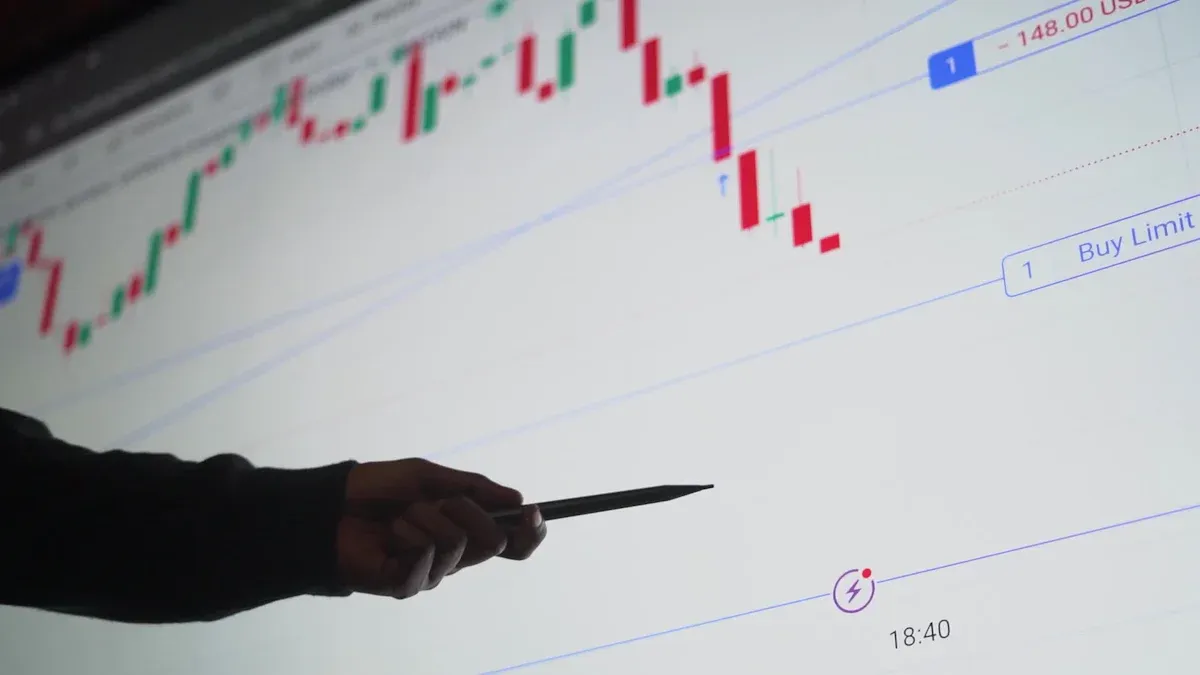
Image Source: pexels
Theory is foundation, but real challenge is practice. Now combine theory with four common trading scenarios to help you understand how to buy US stocks and choose the most suitable order for your goals in different situations.
Scenario 1: Quick Entry to Catch Hot Momentum
Recommended: Market Order
When major positive news breaks or a sector suddenly becomes hot with price surging fast, your primary goal is “get in immediately,” not quibble over cents.
Analysis: In this case, speed is everything. Market order’s core advantage is guaranteed execution and rapid speed. After submitting, the broker immediately executes at the then-best market price, ensuring you do not miss the trend takeoff. Using limit orders to wait for an ideal price may cause the stock to rise far away, leaving you completely sidelined.
The early 2021 “Meme stock” frenzy is a classic example. Massive retail investors flooded in, driving prices explosive in short time.
- GameStop (GME)
- AMC Entertainment (AMC)
- Bed Bath & Beyond (BBBY)
In such frenzy, market orders were many traders’ preferred way to quickly build positions.
Note: In sharp volatility, especially around open (9:30 AM Eastern) and close (4:00 PM), market order “slippage” risk increases. This means final execution price may noticeably differ from what you saw when placing. Before ordering, assess if you accept price uncertainty for speed.
Scenario 2: Buy on Pullback at Ideal Price
Recommended: Limit Order
You are very bullish on a company’s long-term prospects but think current price is high, wanting to wait for pullback to a reasonable level before buying. You do not want to watch the screen daily, hoping for automatic execution.
Analysis: This strategy’s core is cost control. Limit orders give you power to set buy maximum price. For example, a stock at $150 but your psychological price is $145. You can set a $145 buy limit order in your trading app.
- In order interface select “limit order”.
- Enter shares to buy.
- In “limit price” field enter
145.00.After submission, the system places your order. It only potentially executes when price drops to $145 or lower. This not only achieves ideal cost entry but saves manual monitoring hassle. This is key to cost control when learning how to buy US stocks.
Scenario 3: Lock in Existing Profits to Prevent Giveback
Recommended: Sell Limit Order
You bought a stock at $100 now up to $180; you are satisfied with this profit. You worry about any-time pullback and want to sell at $200 to lock profits.
Analysis: Sell limit orders help you overcome greed and fear, executing predetermined trading discipline. By presetting target sell price, you avoid emotional early selling or reluctance to exit.
For example, you think Microsoft (MSFT) price may reach $300 in future; set a $300 sell limit order. When price really rises to that level, order automatically executes at $300 or higher.
This approach has significant psychological advantages:
- Enhances Discipline: Forces advance planning and rule adherence.
- Reduces Psychological Pressure: Ensures profits secured, reducing fear of loss.
- Builds Trading Confidence: Successful plan execution boosts confidence in your analysis.
Scenario 4: Set Loss Bottom Line, Build Safety Net
Recommended: Stop Order
After buying a stock, your biggest worry is sudden reversal downward causing severe loss. You want a “safety net” – automatically sell if price breaks a level to avoid larger loss.
Analysis: Stop orders are core risk management tools. They are like “insurance” you buy for each trade. When learning how to buy US stocks, learning stops is as important as learning profits.
So where to set stop price? Here are two common methods:
1. Fixed Percentage Method (e.g., "2% Rule") This is a simple rule: single trade loss should not exceed 2% of total trading capital. For example, with $10,000 account, single trade max loss is $200. Calculate stop price based on this amount.
2. Volatility-Based Method (ATR Stop Method) This is more scientific, considering stock’s own volatility. ATR (Average True Range) measures stock’s average fluctuation over a period. Use ATR multiples for stop distance.
Trading Style ATR Multiplier Stop Distance Day Trading 1.5x – 2.0x Tighter stops Swing Trading 2.0x – 3.0x Moderate stops Position Trading 3.0x – 4.0x Wider stops For example, you buy NVIDIA (NVDA) at 115.88 with 14-day ATR of 7.20. As swing trader, choose 2x ATR stop distance. Your stop price sets at
115.88 - (7.20 * 2) = 101.48.Common Mistakes: Newbies often err in stop setting including:
- Stops Too Tight: Easily shaken out by normal market noise, missing subsequent upside.
- Stops Too Wide: Loses protection meaning; once triggered, loss already large.
- Arbitrary Setting: Based on round numbers or percentages without considering stock’s actual volatility.
Properly using stop orders is key to progressing from newbie to mature when exploring how to buy US stocks.
Advanced Orders: Stop-Limit and Trailing Stop Orders
After mastering basic orders, explore more powerful tools to optimize strategies. Stop-limit orders and trailing stop orders are two advanced instructions providing finer risk control and profit management.
Stop-Limit Order: Balancing Risk Trigger and Price Control
Stop-limit order is a combination of stop and limit orders. It lets you set a stop trigger price while also setting a minimum sell price, better controlling execution price.
This order is especially useful in sharp volatility. It helps avoid ordinary stop orders converting to market and selling at far below expected price in fast drops.
You need to set two prices:
- Stop Price: When price reaches this, order activates.
- Limit Price: After activation, must execute at this price or better.
| Feature | Stop Order | Stop-Limit Order |
|---|---|---|
| Behavior After Trigger | Converts to market order | Converts to limit order |
| Price Guarantee | No price guarantee, may deviate significantly from stop | Price control, executes at specified limit or better |
| Execution Risk | Execution price may be unfavorable | May not execute if price gaps |
Note: Stop-limit order’s biggest risk is no execution guarantee. If price drops past your stop then continues fast falling and gaps over your limit, your order will not execute, potentially facing larger losses.
Trailing Stop Order: Dynamically Lock Profits, Let Gains Run
Trailing stop order is a powerful tool to dynamically lock profits. You do not set a fixed stop price but a trailing offset, which can be fixed amount (e.g., $5.00) or percentage (e.g., 10%).
Its mechanism is very smart:
- As price rises, stop price “moves up” accordingly, always maintaining your set distance from high.
- When price pulls back from high and hits this moving stop price, order automatically triggers to sell.
This way lets you continuously lock existing profits as held stock rises while giving normal fluctuation room, truly achieving “let profits run.”
How to Set Trailing Amount? Depends on your trading style and asset volatility.
- Day Traders: May use tighter stops, like 2% to 5%.
- Long-Term Investors: May set wider stops, like 15% to 20%, or even use “52-week low” as trailing strategy to handle long consolidations.
Tip: Different brokers handle trailing stops differently. Server-side executed trailing stops are more reliable – they continue even if you close software or disconnect network.
In trading world, there is no best order – only the most suitable for your current goal. Market orders pursue speed, limit orders control cost, stop orders manage risk. When learning how to buy US stocks, flexibly use these tools based on your strategy and market conditions.
As successful investors emphasize:
- Peter Lynch suggests asking yourself: “If I’m right, how much can I make? If I’m wrong, how much can I lose?”
- Warren Buffett believes risking important things for unimportant ones is meaningless.
Applying this knowledge to practice helps you make wiser decisions and effectively improve trading performance.
FAQ
Can I modify or cancel submitted orders?
Of course. As long as your order is unfilled, you can find the pending order in trading software anytime and choose to modify price, quantity, or directly cancel. But note fully executed orders cannot be revoked.
Can market and limit orders be used in pre-market and after-hours?
This depends on your broker. Most brokers allow limit orders in pre-market and after-hours. But due to lower liquidity and wider spreads, they usually restrict or prohibit market orders to protect you from sharp volatility impact.
Will my limit order remain valid forever?
No. When submitting limit orders, you usually need to choose order duration. Common options include:
- Day Order: If unfilled by day close, automatically expires.
- Good-Til-Cancelled: Remains valid until manually canceled or filled (usually with 90-day limit).
What is “slippage” and how to avoid it?
Slippage refers to final execution price differing from price seen when placing order. It most easily occurs using market orders in fast volatility.
To reduce slippage, prioritize limit orders as they lock execution price. Or choose trading in stable, high-liquidity periods.
*This article is provided for general information purposes and does not constitute legal, tax or other professional advice from BiyaPay or its subsidiaries and its affiliates, and it is not intended as a substitute for obtaining advice from a financial advisor or any other professional.
We make no representations, warranties or warranties, express or implied, as to the accuracy, completeness or timeliness of the contents of this publication.
Related Blogs of

Say Goodbye to Panic: Master the Winning Rules for Stock Investing in a Bear Market


Want to Invest in the Chinese Stock Market? Start by Understanding the Shanghai Composite Index


2025 Taiwan Stock Market Year-End Review and 2026 Outlook: Can the AI Boom Continue?

2026 China Stock Market Investment Guide: Spotlight on 5 Must-Watch Leading Tech Stocks

Choose Country or Region to Read Local Blog
 Australia
 Austria
 Belgium
 Canada
 Cyprus
 Czech Republic
 Denmark
 Estonia
 Finland
 France
 Germany
 Greece
 Hong Kong
 India
India Indonesia
 Ireland
 Italy
Italy Japan
Japan Latvia
 Lithuania
 Luxembourg
 Malaysia
 Malta
Malta Morocco
 Nepal
Nepal Netherlands
 New Zealand
 Norway
 Pakistan
 Philippines
 Poland
 Portugal
 Romania
 Singapore
 Slovakia
 Slovenia
 South Africa
 South Korea
 Spain
Spain Sweden
 Thailand
 The United States
 Turkey
 United Arab Emirates
 United Kingdom
 Vietnam
Contact Us




BIYA GLOBAL LLC is a licensed entity registered with the U.S. Securities and Exchange Commission (SEC No.: 802-127417); a certified member of the Financial Industry Regulatory Authority (FINRA) (Central Registration Depository CRD No.: 325027); regulated by the Financial Industry Regulatory Authority (FINRA) and the U.S. Securities and Exchange Commission (SEC).
BIYA GLOBAL LLC is registered with the Financial Crimes Enforcement Network (FinCEN), an agency under the U.S. Department of the Treasury, as a Money Services Business (MSB), with registration number 31000218637349, and regulated by the Financial Crimes Enforcement Network (FinCEN).
BIYA GLOBAL LIMITED is a registered Financial Service Provider (FSP) in New Zealand, with registration number FSP1007221, and is also a registered member of the Financial Services Complaints Limited (FSCL), an independent dispute resolution scheme in New Zealand.